Research at the UC Berkeley Center for Labor Research and Education
As a senior researcher at the University of California, Berkeley Center for Labor Research and Education, I led and contributed to collaborative research and technical assistance projects on job quality, working conditions, and labor policy, particularly focused on low-wage industries and jobs.
The State of Working East Bay
This series analyzed economic well-being among workers in California’s East Bay (Alameda and Contra Costa Counties). We found that around one in ten East Bay workers were at or “near” the federal poverty threshold, one in three was housing cost-burdened and over half were not paid a family-supporting wage. Racial/ethnic inequality means that Hispanic and Black workers disproportionately reported lower wages and economic well-being.
Savannah Hunter, Leila Tjiang, and Enrique Lopezlira. (Oct 2025). “The State of Working East Bay 2021-2023”. Report. Center for Labor Research and Education.
Press Coverage: KQED News.
Savannah Hunter, Vivian Vazquez, Enrique Lopezlira, and Ken Jacobs. (May 2023). “The State of Working East Bay, 2015-2019.” Report. Center of Labor Research and Education.
Press Coverage: Patch, KPFA Law & Disorder.
Union Density in California
This research analyzes trends in union density and the diversity of California’s union members.
Savannah Hunter, Enrique Lopezlira, and Patrick Wade. (August 2025). “A Profile of Union Workers in the Golden State” in State of the Unions: California Labor in 2024. UCLA Institute for Research on Labor and Employment and UC Berkeley Labor Center.
Resource: Union Density in Three Charts (Aug 2026).
Blog: Patrick Wade and Savannah Hunter. (Dec 2025). “One in Four California Veteran Workers Has a Union”.
Press Coverage: Capital & Main, Daily Californian, KCRW, Los Angeles Times, Lookout Santa Cruz, The Press-Enterprise, Sacramento Bee, Sierra Sun Times.
Savannah Hunter, Annette Gailliot, Enrique Lopezlira, and Ken Jacobs. (Sept 2023). “California Union Membership and Coverage: 2023 Chartbook.” Report. Center of Labor Research and Education.
Blog: Savannah Hunter. (Sept 2023). “Snapshot of California Union Membership: ‘It’s not your grandfather’s union anymore.”
Press Coverage: CalMatters, KPBS Radio News, KQED News, WorkingNation.
Low-Wage Industries and Policy Impacts
Fast Food
Savannah Hunter. (August 2025). “A Seat at the Table: Sectoral Standards and Worker Organizing in Fast Food” in State of the Unions: California Labor in 2024. UCLA Institute for Research on Labor and Employment and UC Berkeley Labor Center.
Savannah Hunter, Aida Farmand, Enrique Lopezlira, and Ken Jacobs. (February 2025). “Estimating the impact of California’s $20 fast-food minimum wage on Medi-Cal eligibility”. Report. Center for Labor Research and Education.
Homecare
Nari Rhee, Ken Jacobs, Laurel Lucia, Enrique Lopezlira, Alexis Manzanilla, Savannah Hunter, and Kelly Quinn. (January 2025). “Analysis of the Potential Impacts of Statewide or Regional Collective Bargaining for In-Home Supportive Services Providers.” Report prepared for the California Department of Social Services.
Press Coverage: Capital and Main, Sacramento Bee.
Early Childhood Education
I updated the Labor Center’s Public Cost of Low-wage Work Model to estimate early childhood educators’ participation in social safety net programs due to low-wage wages nationwide and by state (and associated government spending) supporting the UC Berkeley Center for the Study of Childcare Employment’s Early Childhood Workforce Index 2024.
Job Quality in the Public Sector
Savannah Hunter, Sara Hinkley, Adriana Hernandez Castaneda, and Enrique Lopezlira. (Dec 2023). “Civil Service Vacancies in California: 2022-2023”. White Paper. Center of Labor Research and Education.
Press Coverage: CalMatters, Long Beach Post, The Press Democrat.
Research cited in bill analysis for California AB 2561.
Aida Farmand, Tynan Challenor, Savannah Hunter, Enrique Lopezlira, and Ken Jacobs. (March 2023). “State workers struggle to make ends meet throughout California; Women, Black, and Latino workers are disproportionately affected.” Report. Center of Labor Research and Education.
Press Coverage: The Appeal Democrat, CalMatters, The Davis Vanguard, Sacramento Bee, The San Diego Voice & Viewpoint.
The Low-wage Work Data Explorer
I led an update to the Labor Center’s Low-wage Work in California Data Explorer. The Labor Center’s tool provides essential data to the public on the over 5.6 million Californians paid low wages including demographics, industry and occupation information, job quality characteristics, and the relationship between low wages, poverty, and social program usage. My vision involved redesigning the data-heavy tool to improve accessibility for people with disabilities and lower data literacy levels, and better communicate the story of low wages for a public audience. We also expanded inclusion in the analysis by providing new analysis on American Indian and Alaska Native and Asian American and Pacific Islander workers.
Savannah Hunter, Enrique Lopezlira, Kassandra Hernandez, and Ken Jacobs (July 2024). “Low-Wage Work in California Data Explorer 2024”. Data Tool. Center for Labor Research and Education.
Blog Post: Savannah Hunter and Enrique Lopezlira. (July 2024). “Five Things You Might Not Know About Low-Wage Workers in California”.
Blog Post: Savannah Hunter. (Sept. 2024). “Labor Day Reflections on Racial, Ethnic, and Gender Inequality in California’s Low-wage Workforce”.
Labor Center Video: “Who is Paid Low Wages in CA?”
Press Coverage: Associated Press, CalMatters, Capital and Main, Daily Californian, KPFA, Sacramento Bee.
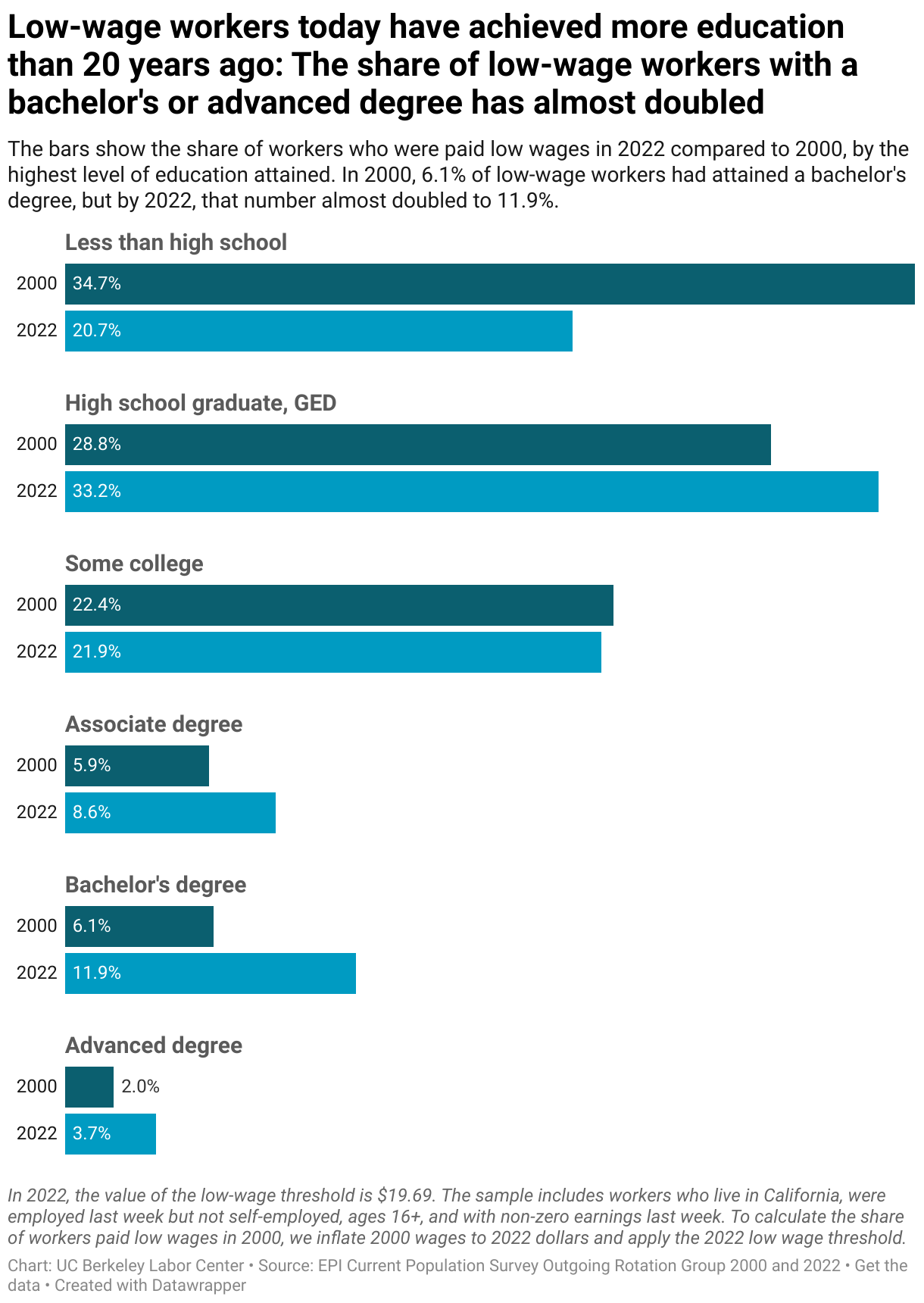
Designing for story-telling and accessibility
To improve accessibility in the new Data Explorer each chart provides a clear message, describes what the visualization shows for a non-technical audience, and follows Web Content Accessibility Guidelines for color contrasting, clear labeling, and alt-text.